01 : Fruit Life
For my great-grandmother, who passed away far from “home”. For my grandmother, who married into this family from 950 kilometers away and is still healthy. And For my other grandmother, who also married far away, now living alone in another city.
In the Ndebele tribe of Africa, people believe that if a family member dies far from home, the fruit of a Kigelia is buried where the body lies.
Introduction
Life is not easy for one living in a nursey home. The paradoxical dependency and needs for dignity render their vulunerability in the relationship with caregivers. Being taken care of can be interpreted as a denial of atonomy, hurting the "care-suffers".
The creepy fruit hung in a metal cage, in a small room, is watched by us, like how "they" are watched and taken care of in the nursey home.
It dodges when you approach. It trembles when you touch.
The structure and interaction of fruit is inspired by the fruit of Kigelia (Saussage Tree). Kigelia fruit consists of a hard cover and textured flesh. The wooden fruit is usually harshly cut into halves, showing its inside: seeds hugged by fiber.
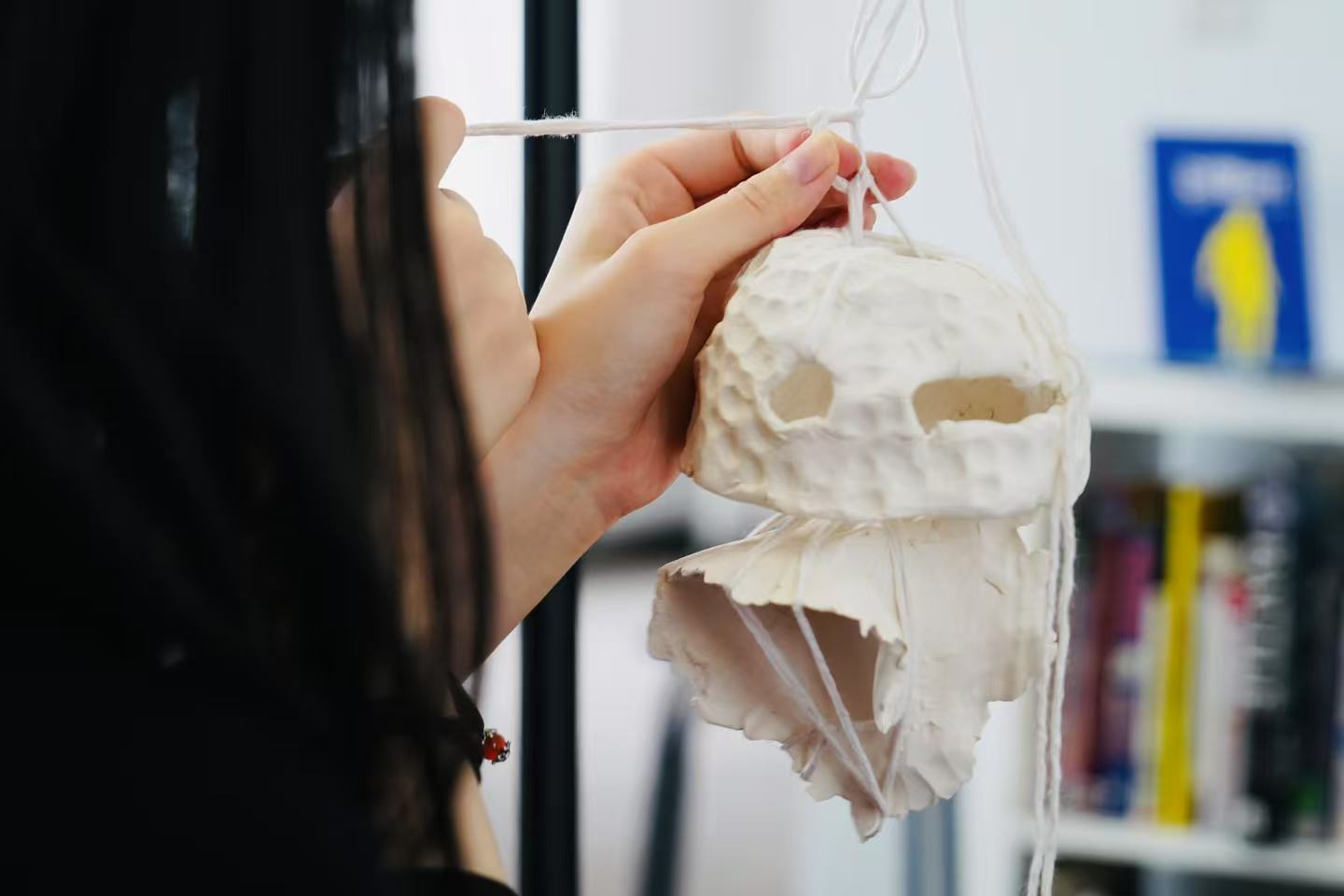
Hanging the fruit core
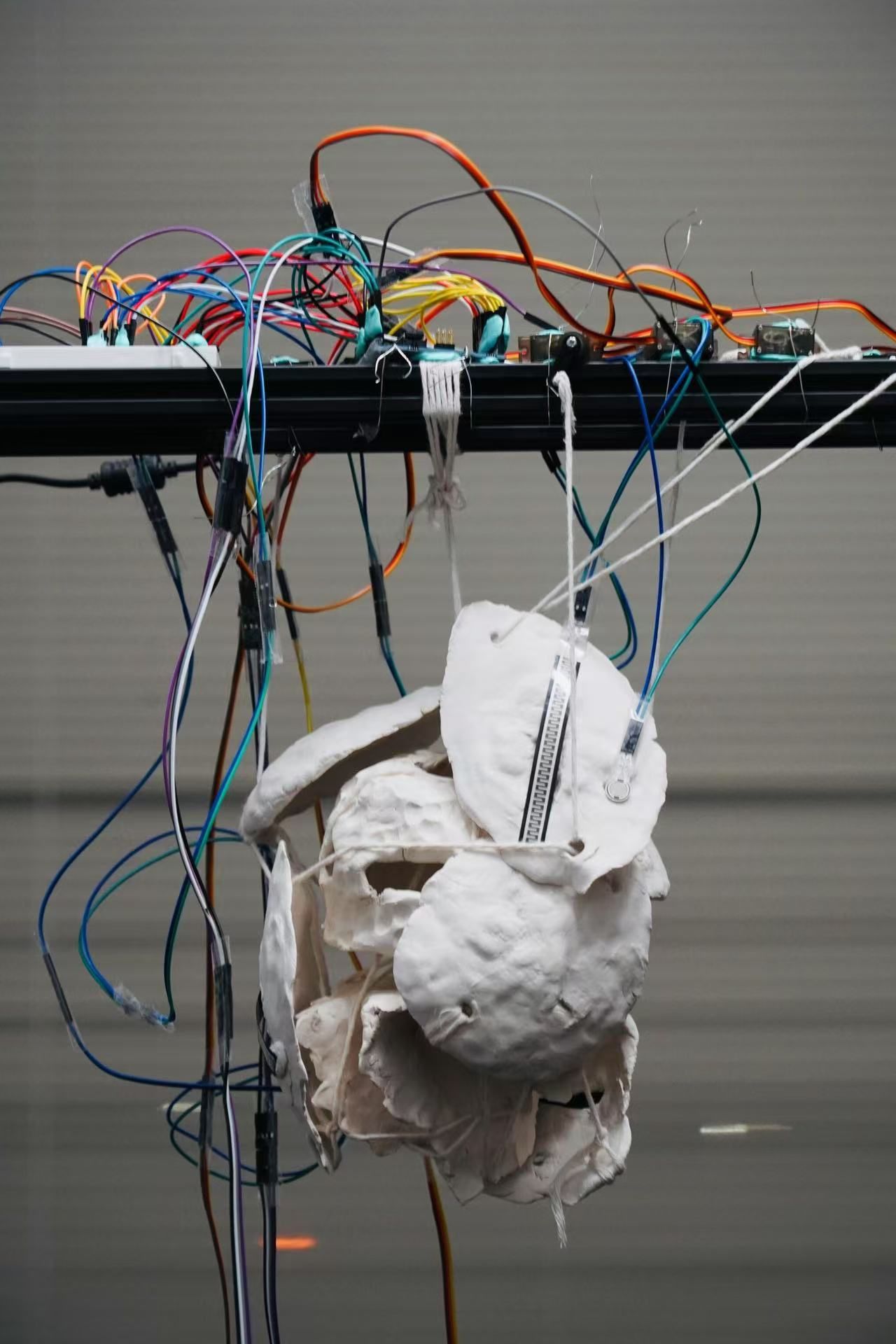
The fruit
Interaction
Approach
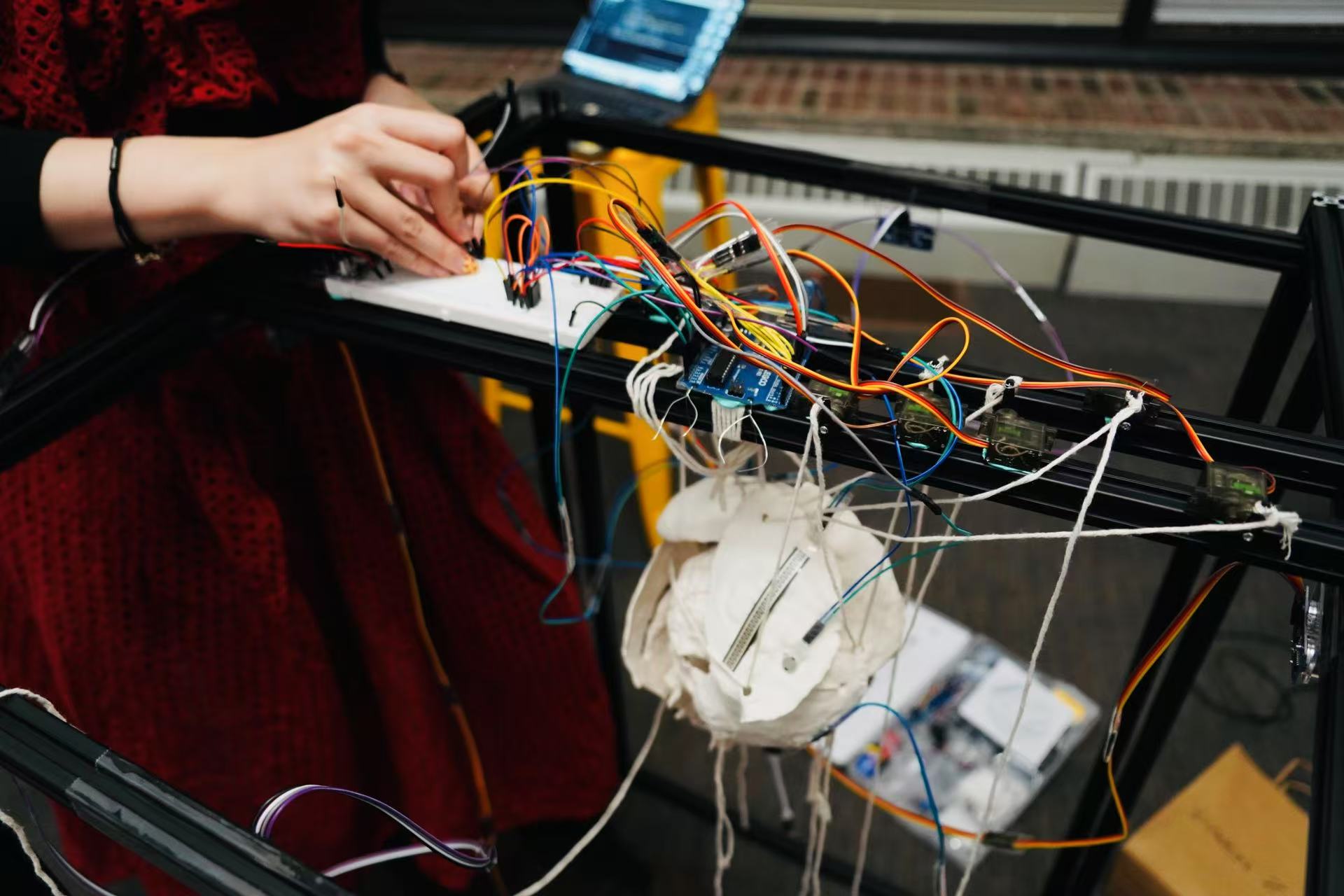
The fruit acts to approach to mimic the fear, curiosity, eye contact reaction of the elderly when caregivers are around.Four ultrasonic distance sensors are equipped on the frame, facing each direction to detect whether there is audience approaching, and the speed of approaching. When approached, the fruit dodges to the opposite direction to an extent based on the spped of audience. If there is someone nearby without approaching, the fruit raises her head to the audience curiously.
Touch
Multiple pressure sensors and flex sensors are attached to the surface of the fruit, monitoring the force applied on it. The fruit swings and trembles when being touched as if their scars are touched. What kind of scars? A strong desire to be cared not only physically, but emotionally. A strong desire to lead a decent late time. The trembling reflects their struggle in the caregiver relationship: having no choice but to depend on; having no autonomy but desiring love.
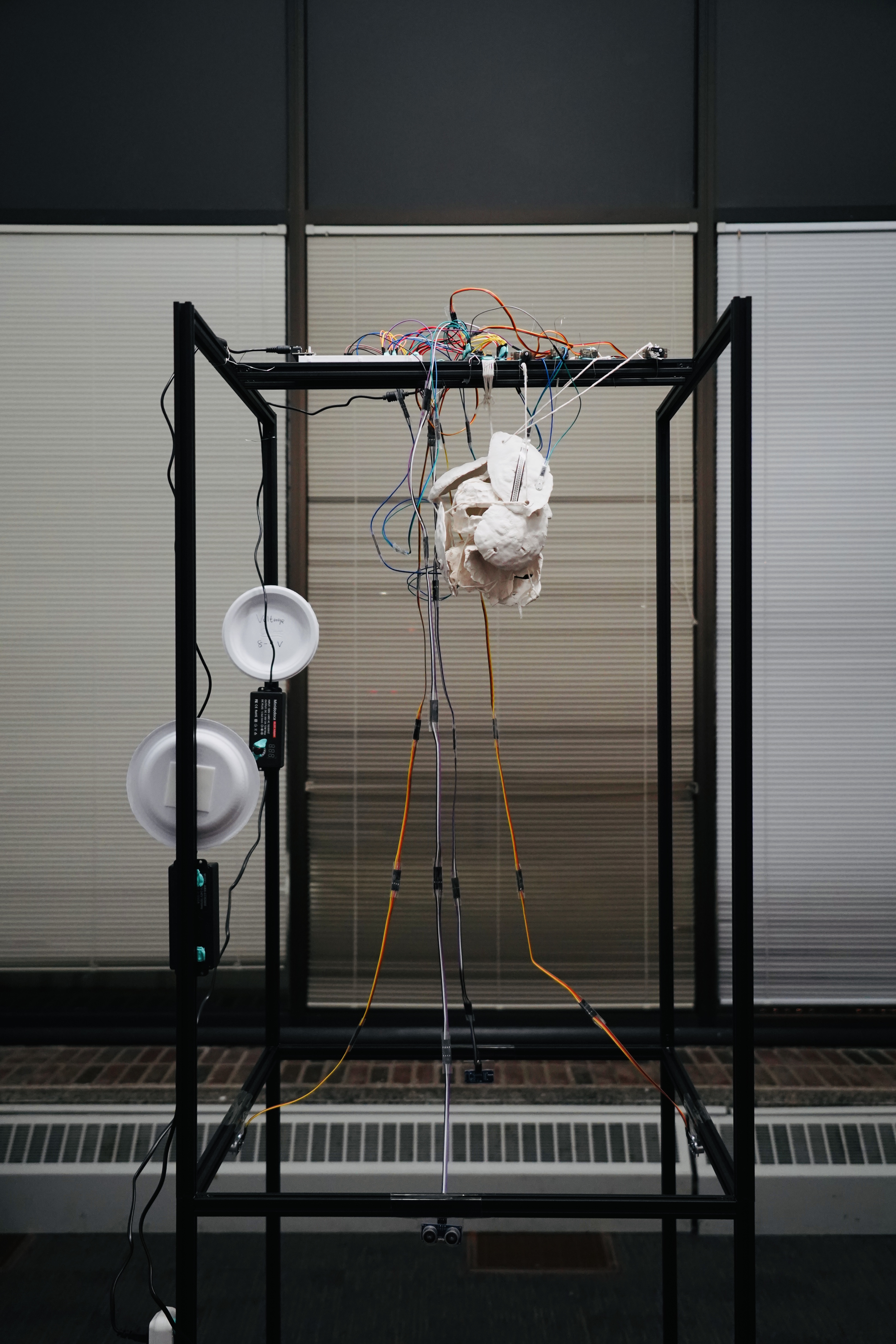
Overview of the installation
Structure
The Core
Upper Half
A hollow hemispherical structure with circular openings on its surface houses a distance sensor inside, receiving signals through the circular openings. The topmost opening connects to a load-bearing structure for suspending fruit.
Lower Half
A petal-like structure with cavities between the petals designed to house cell load sensors. The five-petal design corresponds to the structure of the Kigelia flower.
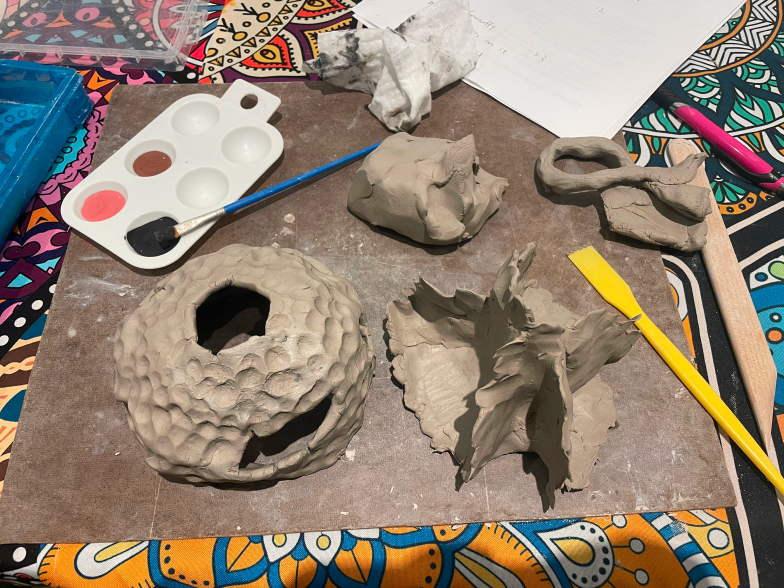
The core before firing
Outer Layers
Several Patel-like Structures covering the fruit core. An irregular petal-like structure is composed of multiple irregular clay blocks connected by threads. A motor controls the threads’ tension, adjusting the angles and relative positions of the clay blocks to create deformation.
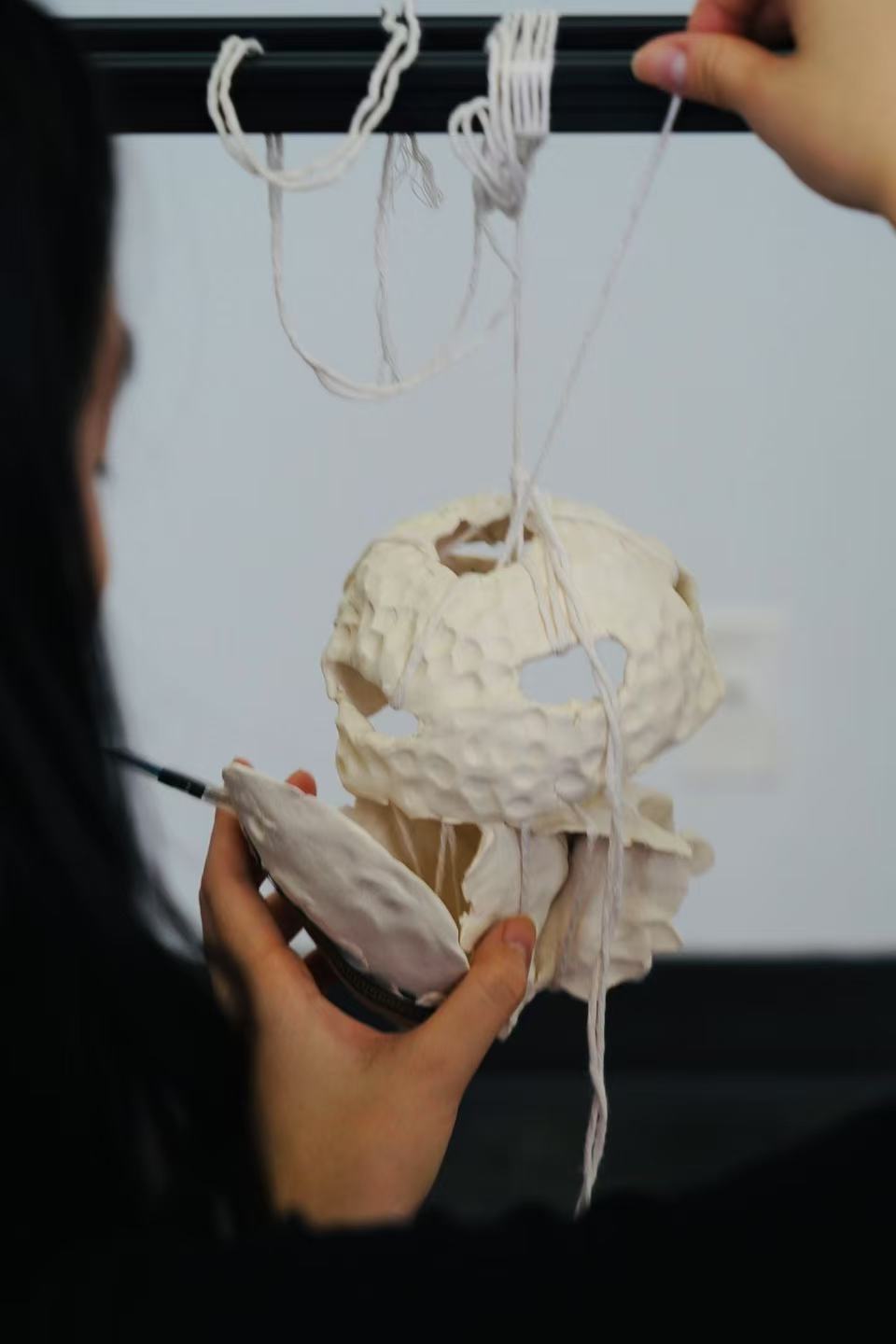
Installing outer layers
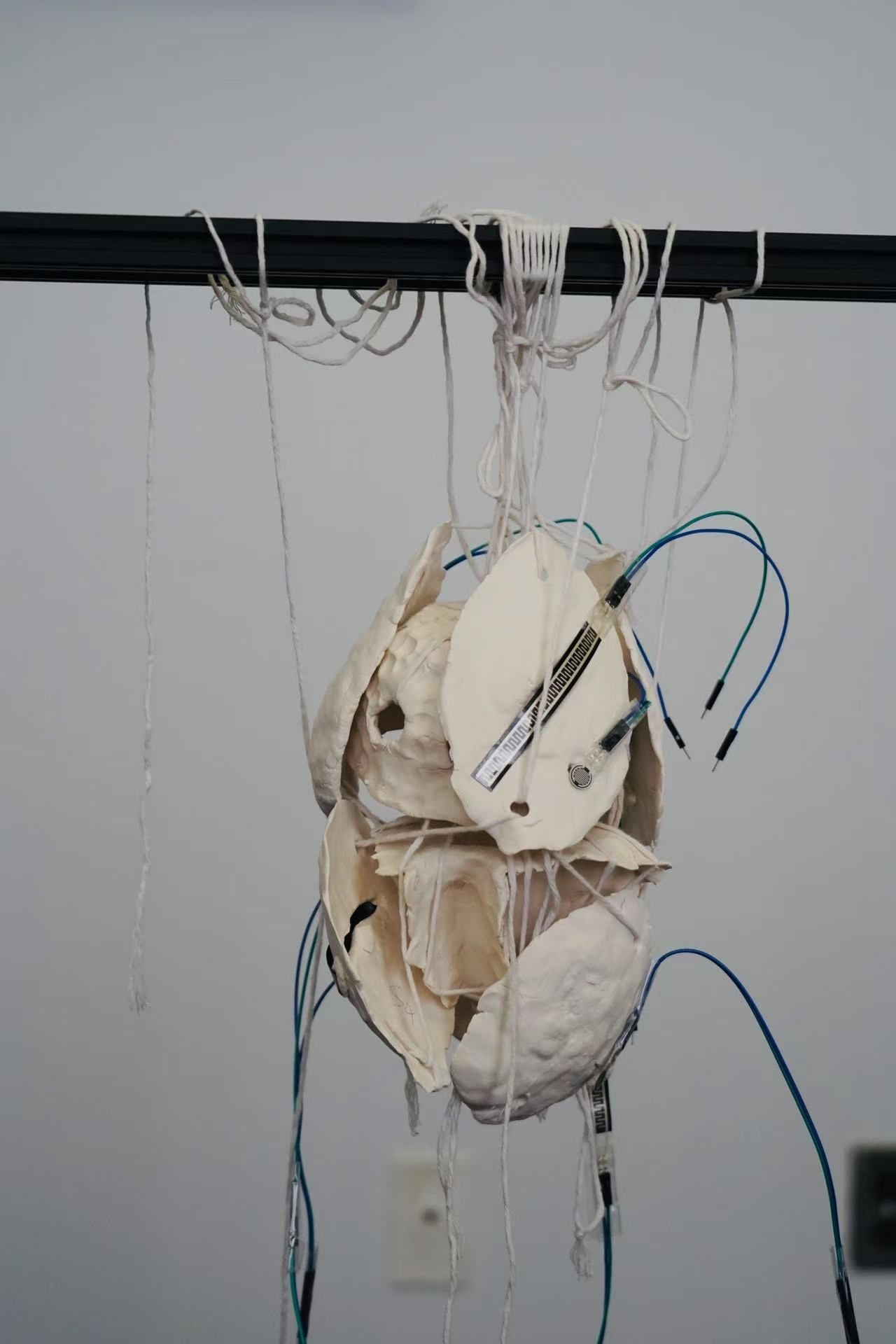
Outer layers with sensors
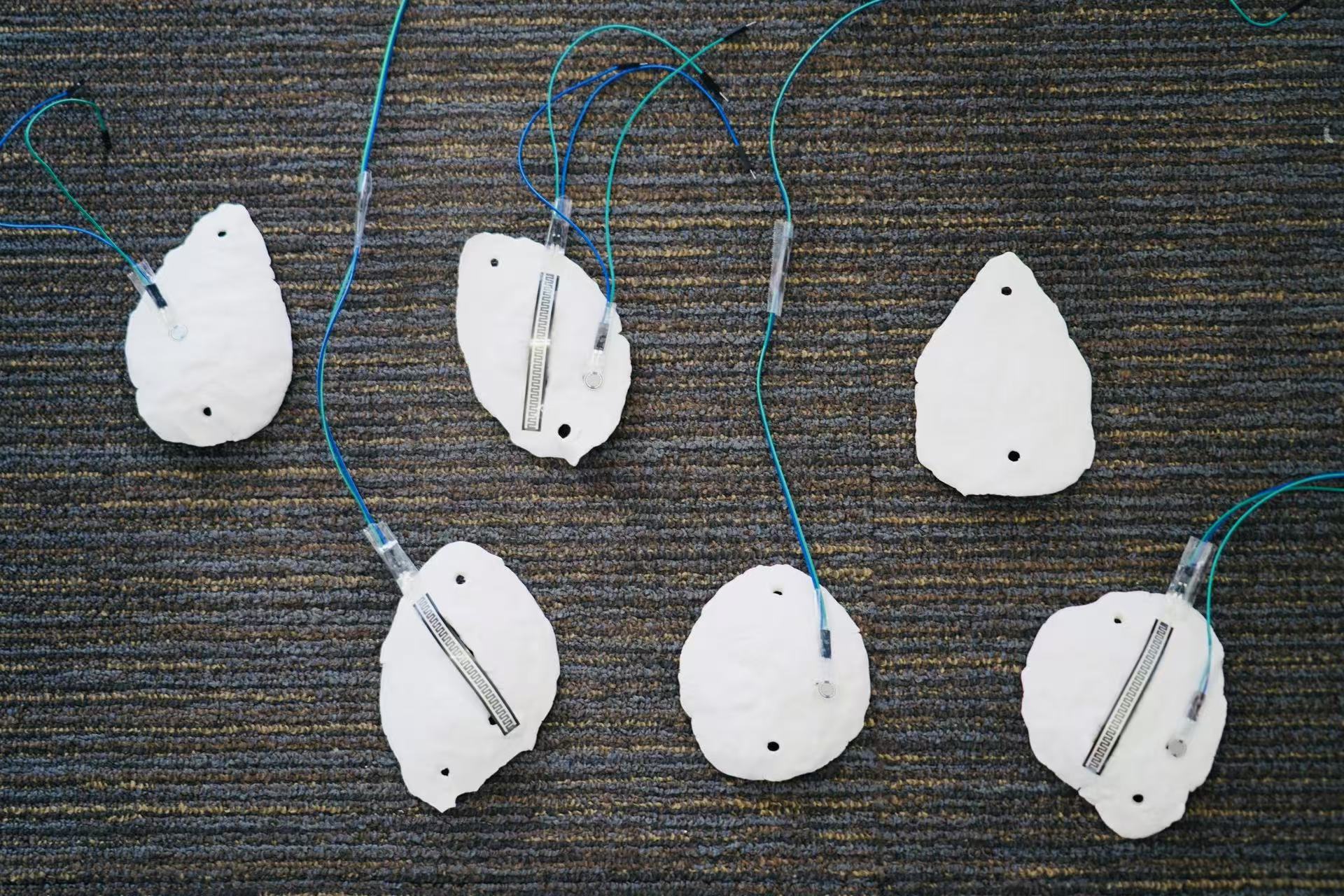
Overview of 6 petal-like layers
Story Behind
My great-grandmother passed away when I was in my senior year of high school. For the first 18 years of my life, I thought she was my biological great-grandmother, my grandmother's mother. It wasn't until a casual family conversation that I learned the truth. My grandmother's birth mother had passed away when she was very young. My great-grandfather later married my great-grandmother, who raised three children that weren't her own. She never had biological children herself.
In my memory, she was a kind, petite elderly woman. During Lunar New Year, she would call me by my nickname in her dialect and press red envelopes with money into my hands. Inside, there were coins and small bills of one yuan and five yuan. My sister and I would count them, and I’d find my sister’s total was a bit higher than mine.
My great-grandfather and great-grandmother lived in a tiny apartment in the city center. At the entrance to their neighborhood, there were vendors selling cheap but delicious fruit and all kinds of snacks. After my great-grandfather passed away in his 80s, my great-grandmother moved into a nursing home. I later heard she didn’t get along with the cultured woman she shared a room with, so she was moved to another room.
Sometimes we visited her. I would help her into a wheelchair and push her through the long corridors of the nursing home, then into the elevator, and up to the rooftop garden. There, I pushed her wheelchair in slow, steady circles. I can no longer remember what we talked about.
The wheelchair went round and round until a nurse came by. The nurse greeted her and pointed at me, asking, “Who is she? She looks so much like you.” We told her I was her great-granddaughter. Not long before this, I had learned she wasn’t biologically related to me. I don’t know what she thought when she heard that question. Shortly after, she passed away.
In the Ndebele tribe of Africa, people believe that if a family member dies far from home, the fruit of a Kigelia (Sausage Tree) is buried where the body lies. They also believe the tree can heal illnesses and drive away evil spirits.
I never heard my great-grandmother talk about her friends or family. No one else in the family ever mentioned them either. During her decades with my great-grandfather, her sense of self seemed to be wholly absorbed into her role in this family. Yet, I could still sense a kind of distance from some family members. She was someone who passed away far from her “home”, whether that “home” was this family or her own. She deserved a Sausage Tree, growing in some faraway desert.
In my family, women who marry into the family from far away play an essential role. They bring vitality, sometimes gentle, sometimes fierce, to this family. They give it life and energy. But more importantly, they are lively, lovable, memorable, and a little stubborn. I want to show you the shape of their lives. Or rather, I want you to see, through the growth and breaking of this fruit, the form of life it holds within.